
A scientific study
Difficulties connected with dating of early clay lamps and Deneauve’s Typology of Punic Lamps.
The clay lamps invented by the Phoenicians in c.3000 BC have had a pretty consistently copied in every place until about 200 BC, which makes it difficult to date them.
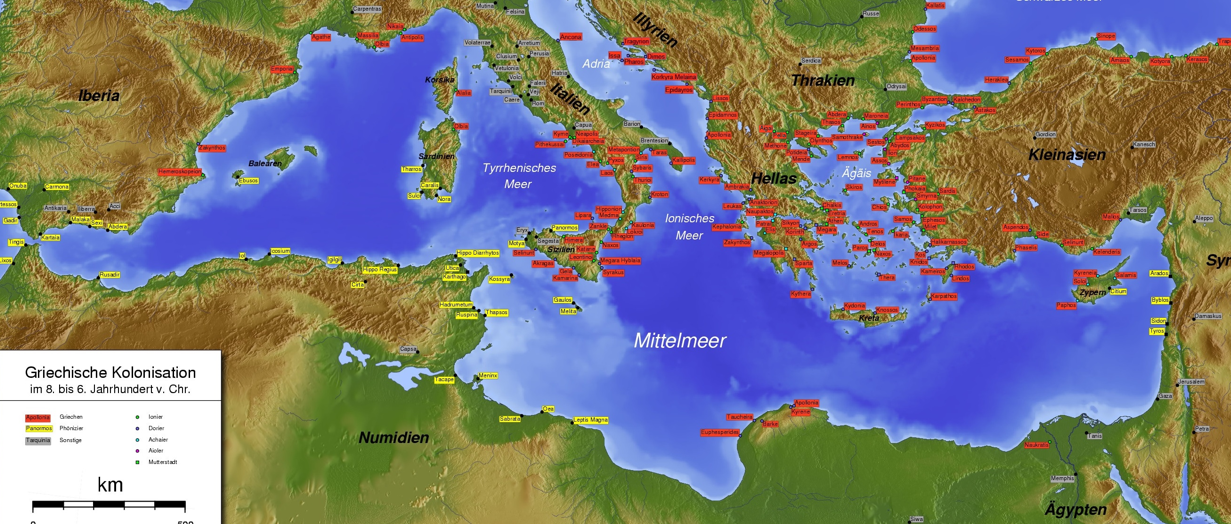
This means that in many cases the best we can rely on is looking at the differences in clay and the shapes prevalent in different regions, which is in no way sufficient for accurate dating. Many local lamps were also influenced by earlier examples from different regions, making the already hard situation worse. The difficulty of dating a single nozzle lamps can be lowered if the finding spot is known. It is also worth noting that lamps with two nozzles are very rare in Phoenicia, and very popular in the West, as well as Cyprus. We can also tell based on the clay, whether the lamp was made locally, or was imported from elsewhere.
One of the marks that can be used to identify lamps from Carthago is the presence of painted strips on the lamp.
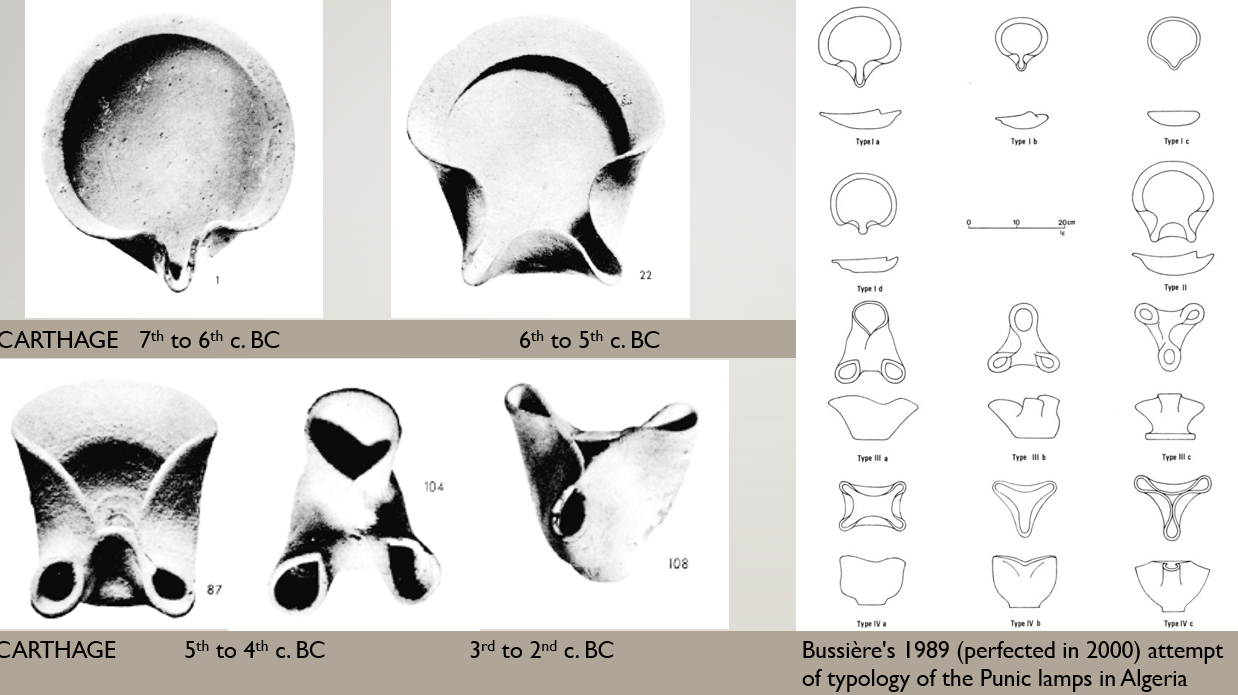
While there are different Typologies focusing on different regions, my study focuses on Deneauve’s Typology of Punic Lamps, which showcases the evolution of lamps in Carthage until c. 200 BC.
Another typology of Punic Lamps was created by Jean Bussière.
Deneauve’s Typology
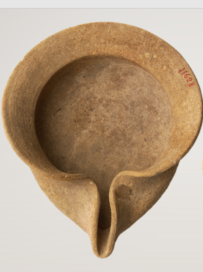
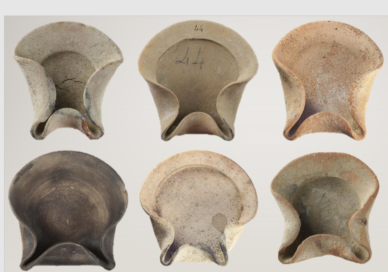
Deneauve’s typology focused on lamps from Carthage includes types I-IV and VII-X, dated from c. 7th to 2nd century BC.
Type I was the standard Phoenician one nozzle lamp, which later evolved into Type II and III, which had two nozzles and were open. Type II was identical to Type III, with the only difference being that Type II is considerably more rare and was covered with red slip. Those three types are dated between 7th to 5th century BC.
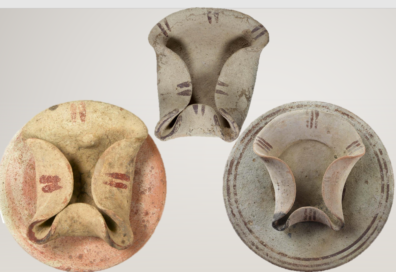
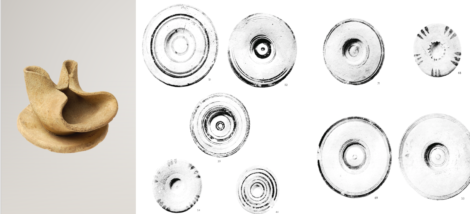
The appearance of Type IV is also nearly identical to Type III, with Type IV being smaller,as well as having painted strips and sometimes a dish made to imitate neo-assyrian lamps in one piece. This type was produced since the end of 5th century BC.
The shape of the reservoir begins to change with Type VII, with the reservoir becoming concave, and the lamp itself being broadly open. It was produced from the middle of 4th century BC.
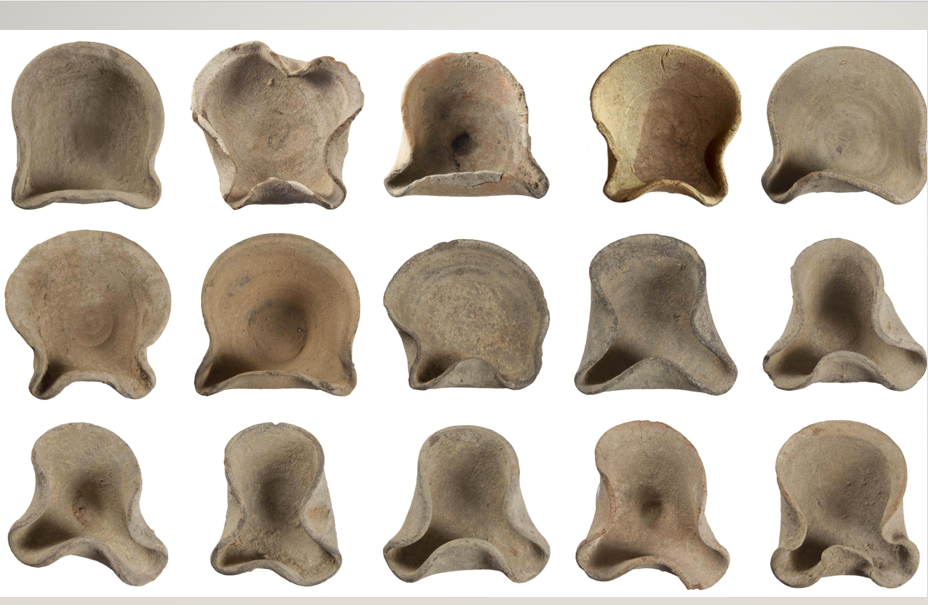
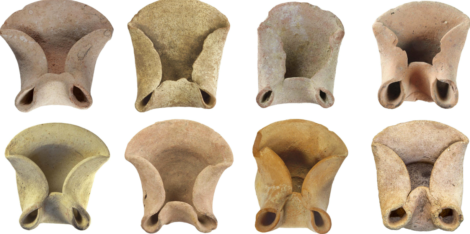
With the appearance of Type VIII, the reservoir becomes even more concave, and the nozzles become tubular. This type was produced between 4th and 3rd century BC.
Those changes are even more pronounced in Type IX, where besides two tubular nozzles and concave reservoir, a sizable tubular opening used to fill the lamp is added. This variant was produced since the late 3rd century BC.
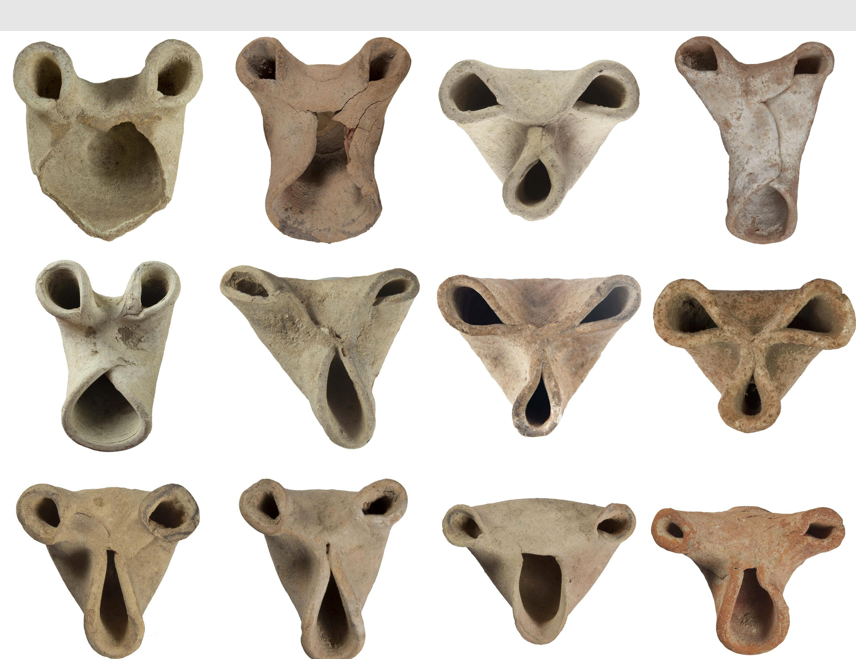
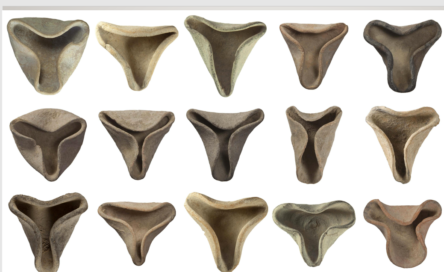
Another type of lamp called Type 4b, this time from Bussière’s typology, similiar to Type IX, with three open nozzles, or two nozzles and a filing side, as well as a concave reservoir.
The last type, Type X, has the most differences from the previous types, with the reservoir being concave and closed, and with three tubular nozzles. This type was produced since the middle of the 2nd century BC.
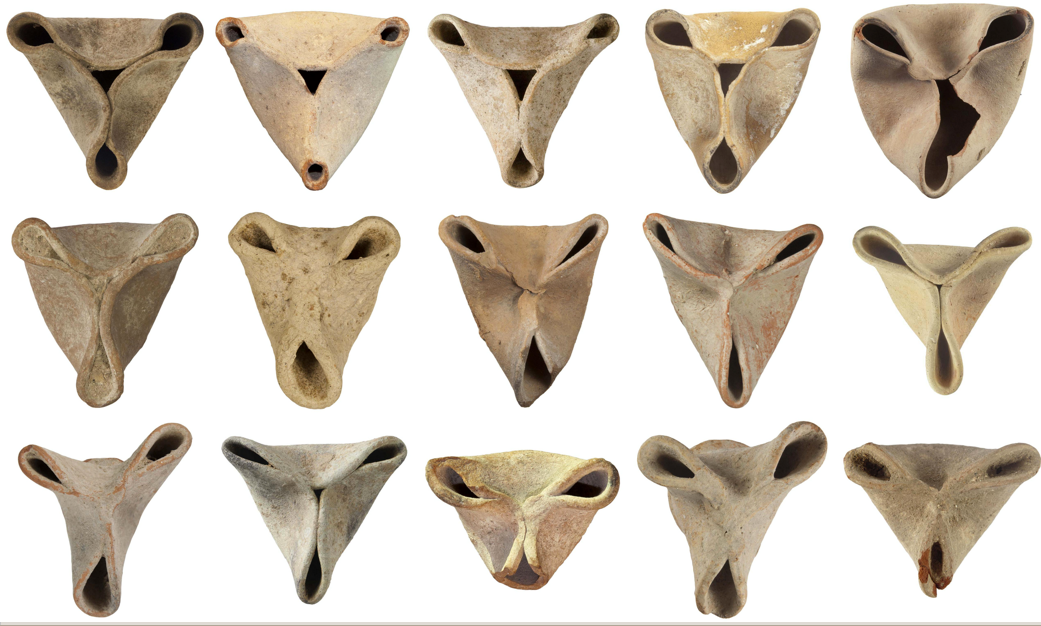
While the shape of Punic lamps changed over time, in other places we can find similiar shapes, which appeared later. This shows that we cannot use a single typology to date lamps from everywhere. At the same time, we can at least use those typologies to roughly tell how, where and when the shapes of the lamps evolved in certain ways.
Conclusion
While dating the early clay lamps is tedious and difficult, it is possible to create separate typologies for specific regions and follow the development of the lamps, as shown in Deneauve’s typology. In the case of Punic lamps, the Phoenician single nozzle lamp gave way to the double-nozzled lamps, which over time became more concave and shifted from open to closed, with the nozzles becoming tubular and replacing any openings used to fill the lamps.
Source
3101 – AKLIGHT N.02, The Phoenician Invention of The Clay Lamp And Its Consequences. – Prof. Univ. Dr. Habil. Laurent Chrzanowski
Bibliography
Bussi re, J. (1989). Les lampes phénicopuniques d’Algérie. Antiquités Africaines, 25, 41–68
Deneauve, J. (1974). Lampes de Carthage. Paris : Editions du Centre National de la Recherche Scientifique
Sussman, V. (2007). Oil-lamps in the Holy Land: Saucer lamps. From the beginning to the Hellenistic period: Collections of
the Israel Antiquities Authority [=BAR IS 1598]. Oxford : Archaeopress
Bussière, J. (2000). Lampes antiques d’Algérie [=Monographies Instrumentum 16]. Montagnac : éditions Monique Mergoil