
A general public presentation
Deneauve Typology of Punic Lamps
Due to the lamps being mostly identical in design until 200 BC, it is quite hard to tell the origin of the lamps, much less create a typology of concrete region.
The Typology created by Jean Deneauve showcases the evolution of lamps in Carthage.
Deneauve’s typology focused on lamps from Carthage includes types I-IV and VII-X, dated from c. 7th to 2nd century BC.
Type I was the standard Phoenician one nozzle lamp, which later evolved into Type II and III, which had two nozzles and were open. Type II was identical to Type III, with the only difference being that Type II is considerably more rare and was covered with red slip. Those three types are dated between 7th to 5th century BC.
The appearance of Type IV is also nearly identical to Type III, with Type IV being smaller,as well as having painted strips and sometimes a dish made to imitate neo-assyrian lamps in one piece. This type was produced sinve the end of 5th century BC.
The shape of the reservoir begins to change with Type VII, with the reservoir becoming concave, and the lamp itself being broadly open. It was produced from the middle of 4th century BC.
With the appearance of Type VIII, the reservoir becomes even more concave, and the nozzles become tubular. This types was produced between 4th and 3rd century BC.
Those changes are even more pronounced in Type IX, where besides two tubular nozzles and concave reservoir, a sizable tubular opening used to fill the lamp is added. This variant was produced since the late 3rd century BC.
Another type of lamp called Type 4b, this time from Bussière’s typology, is similiar to Type IX, with three open nozzles, or two nozzles and a filing side, as well as a concave reservoir.
The last type, Type X, has the most differences from the previous types, with the reservoir being concave and closed, and with three tubular nozzles. This type was produced since the middle of the 2nd century BC.
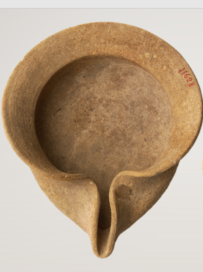
Picture 1 – Example of a Phoenician shape lamp with one nozzle – Deneauve Type I
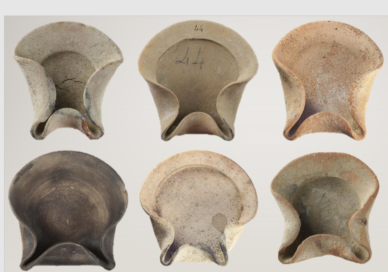
- Picture 2 – Deneauve type II and III
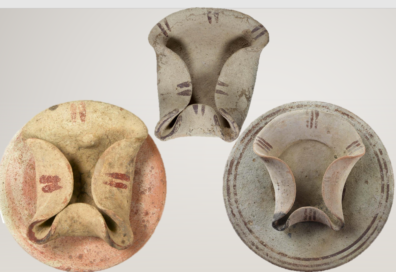
Picture 3 – Deneauve Type IV
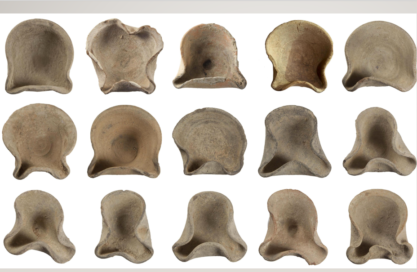
Picture 4 – Deneauve Type VII
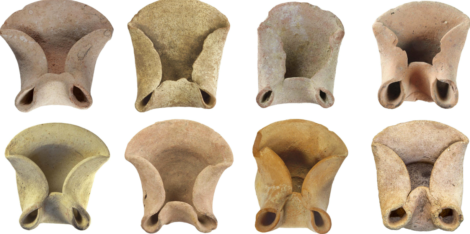
Picture 5 – Deneauve Type VIII
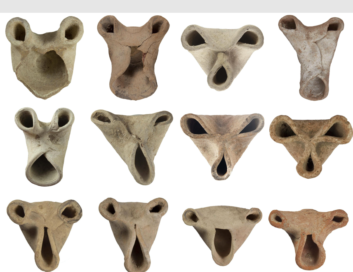
Picture 6 – Deneauve Type IX
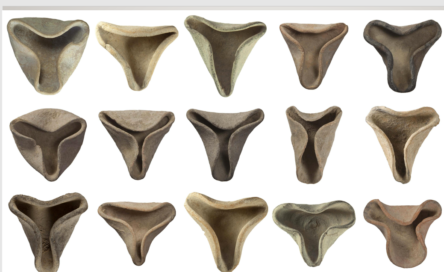
Picture 7 – Bussière Type IVb
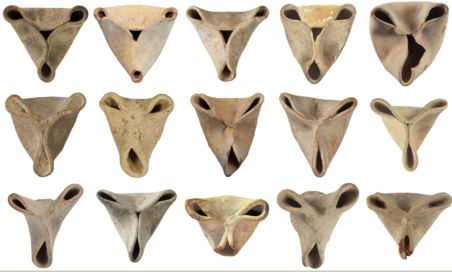
Picture 8 – Deneauve Type X